Thursday, April 25, 2013

A Study in Munch (the artist, not the verb...although that would be tasty)


When people ask me what I studied in college and I reply with art history, they usually respond in one of two ways. The first is by asking whether I paint or draw, assuming that I am an artist. The second is to reply with a generic “oh that’s neat!” I can tell, however, by the blank look in their eyes that they have no idea what art history entails. Art historians study the evolution of the visual arts throughout time and the important role that art plays in the development of culture. Art historians approach a piece of art in two ways: we examine the history/artist/time period of a work of art—called contextual analysis—and just as, if not more importantly we use our eyes and sometimes other senses to examine the visual qualities (color, technique, composition, etc.) of a work of art—called visual analysis. The contextual aspect of a work of art is often quite fixed but it is the visual one that is personal and varies from viewer to viewer. It is this sensual and visually stimulating aspect of art that first drew me to study the history of art. Below is my visual analysis of one of history’s most famous paintings, The Scream, by the Norwegian artist Edvard Munch.

Immediately my eyes are drawn to a pale figure in the foreground whose mouth is open as if screaming and whose hands are pressed to its face in abject terror. One can almost see this scream vibrating across the canvas in the form of the painting’s wavy strokes. The sky is laced with thick, vibrant ribbons of fiery orange and yellow which contrast with the somber black and cool blue that make up the rest of the scene. These contrasting colors produce a mood of turmoil and conflict. The figure seems to be standing on a bridge that cuts the painting with a strong diagonal. The gravitational force of this diagonal conjures up a sense of inevitable fate. Two tall figures looming in the background appear to be steadily approaching the main figure which combined with the position of the viewer in front of the figure creates the sense that the figure’s position is inescapable.  

Saturday, April 20, 2013

Beauty Amid the Brokenness

It is not an infrequent sight to find me taking an evening beach walk by myself; I am an introvert, so I recharge by being alone with my thoughts and for me, this is often outdoors with a camera in hand. Last week I took the following photo while on one of these strolls.  As I was walking back to my house I noticed this patch of weeds growing beside a fence. Now often people just walk by weeds but I couldn’t help but be struck by their color and beauty.  I made my way over to them and despite being attacked by a swarm of blood lusty mosquitoes, I refused to recede until I had taken a couple photos.  One of my life mottos as you can see on my profile is that good things come in small packages. I firmly believe that the little things and private moments that are often taken for granted make life so much sweeter and interesting. Ask anyone who knows me well and they will tell you that I have always had a deep appreciation for the small, simple and perhaps even what some would consider the mundane things of life.

 
While looking at this photo on my computer it got me to thinking (no surprise there).  These weeds which are considered undesirable and inconsequential are not unlike humans when compared to the powerful, holy, infinite God of the universe. How thankful I am that our gracious Lord was able to find beauty in the brokenness and insignificance of man! When I start to feel downcast or resentful about life (which is more frequent sometimes than I would like) I try to focus on the little things around me; I cannot remain sad for long because it reminds me that I am the daughter of an omnipotent creator God who found beauty amid the brokenness.


Monday, April 1, 2013

A Beautiful, Poignant Prayer

The Awakened Sinner

From Valley of Vision
 
O my forgetful soul,
Awake from your wandering dream;
turn from chasing vanities,
look inward, forward, upward,
view yourself,
reflect upon yourself,
who and what you are, why here,
what you must soon be.
You are a creature of God,
formed and furnished by him,
lodged in a body like a shepherd in his tent;
Do you not desire to know God’s ways?
O God,
You injured, neglected, provoked Benefactor
when I think upon your greatness and your goodness
I am ashamed at my insensibility,
I blush to lift up my face,
for I have foolishly erred.
Shall I go on neglecting you,
when every one of your rational creatures
should love you,
and take every care to please you?
I confess that you have not been in all my thoughts,
that the knowledge of yourself as the end of
my being has been strangely overlooked,
that I have never seriously considered
my heart-need.
But although my mind is perplexed and divided,
my nature perverse,
yet my secret dispositions still desire you.
Let me not delay to come to you;
Break the fatal enchantment that binds
my evil affections,
and bring me to a happy mind that rests in you,
for you have made me and canst not forget me.
Let your Spirit teach me the vital lessons of Christ,
for I am slow to learn;
And you hear my broken cries

Tuesday, March 12, 2013

Insistent about the Sistine

I'm not a Catholic so I will leave the whole Pope business to those who are, although the article below is one of the best views on it that I have read.

http://www.latimes.com/news/opinion/commentary/la-oe-new-cole-next-pope-20130312,0,1339463.story

As the Cardinals prepare to begin their deliberations in the Sistine Chapel I look at this as a time to focus on what else? Art of course!! Just click on the link below to enjoy the artistic beauty of this sacred spot.

http://www.vatican.va/various/cappelle/sistina_vr/index.html

Wednesday, February 20, 2013

Gun "Control"

I’m not one to try and force my political opinions on others because I know how annoying that can be. For that reason I usually don’t share my political opinions except with family or close friends. Since a lot of people, however, seem to be talking about the gun control issue and because I work next to guns on a daily basis— though be it very large and old ones—I thought I would share my view on gun control from the perspective of history. The idea of the present learning from the past is so important and should be considered no less when looking at the issue of gun control. First of all, like any good historian we must make sure we are using the correct terms. After all our aim is to be accurate, and yes, pun intended. The widely used labels “assault weapons” and “high capacity magazines” are nothing more than media-manufactured terms. The “assault weapons” are ordinary semiautomatic rifles — not machine guns — identical in function to rifles that have been in use for more than a century. The “high capacity magazines” are actually standard magazines that have been manufactured for more than 70 years.
So let’s look at what has been done about gun control in the past by considering California and New York City which have some of the strictest gun laws in the country. Stricter gun laws in California started in earnest with the Roberti-Roos Assault Weapons Control Act of 1989. Yet these laws have not kept guns out of the hands of criminals and they have not significantly lowered gun crimes. New York City has had strict gun control laws since 1911, yet it also ranks among the most dangerous places in the country and large numbers of killings by gun still occur. If stricter gun laws haven’t worked at the civic or state level then why would it work at the federal level? A study conducted in 2009 by the Center for Disease Control found “insufficient evidence” that gun laws did anything to prevent gun violence. America needs to focus on what is really at the heart of many mass shootings. I am in favor of finding an effective way to monitor those who have a history of mental illness or making violent threats in order to prevent them from obtaining guns. The whole issue of mental health is something that needs to be re-examined in America, but banning certain kinds of guns or making it harder for everyone to buy a gun is not the answer. There is no evidence that restrictive gun control laws would have any deterrent effect on street gangs or other gun-wielding criminals who are already operating outside the law. It could instead encourage an illicit trade in firearms--much as anti-drug laws have sustained the lucrative illegal drug trade.
In the end, past attempts to lower violence through stricter guns laws suggest that more gun control laws would only mean revisiting the same failed policies while infringing on the rights and lives of millions of law-abiding gun owners. Americans would exchange no improvement to public safety for fewer individual liberties which is just not acceptable.
I would like to end my thoughts with a quote from my all-time favorite actor, Charlton Heston. “There's no such thing as a good gun. There's no such thing as a bad gun. A gun in the hands of a bad man is a very dangerous thing. A gun in the hands of a good person is no danger to anyone except the bad guys.”
Below you can see what a gun in my hands looks like. A little over a week ago I went shooting for the first time. It's something I have wanted to try for a long time but never had the opportunity. The instructor said I did very well for a first-time shooter. Watch out bad guys…or at least paper guys.


Sunday, February 10, 2013

Puns for the Educated Mind

I love a good pun! That is one of the reasons I am a big fan of the writing of William Shakespeare. Here are some puns that a friend sent to me so I can't take any credit for them but I hope you enjoy!
 
 
The fattest knight at King Arthur's round table was Sir Cumference. He acquired his size from too much pi.

I thought I saw an eye-doctor on an Alaskan island, but it turned out to be an optical Aleutian.

She was only a whisky-maker, but he loved her still.

A rubber-band pistol was confiscated from an algebra class, because it was a weapon of math disruption.

No matter how much you push the envelope, it'll still be stationery.

A dog gave birth to puppies near the road and was cited for littering.

A grenade thrown into a kitchen in France would result in Linoleum Blownapart.

Two silk worms had a race. They ended up in a tie.

A hole has been found in the nudist-camp wall. The police are looking into it.

Time flies like an arrow. Fruit flies like a banana.

Atheism is a non-prophet organization.

Two hats were hanging on a hat rack in the hallway. One hat said to the other, “You stay here; I'll go on a head.”

I wondered why the baseball kept getting bigger. Then it hit me.

A sign on the lawn at a drug rehab center said 'Keep off the Grass'.

The midget fortune-teller who escaped from prison was a small medium at large.

The soldier who survived mustard gas and pepper spray is now a seasoned veteran.

A backward poet writes inverse.

When cannibals ate a missionary, they got a taste of religion.

If you jumped off the bridge in Paris, you'd be in Seine.

A vulture carrying two dead raccoons boards an airplane. The stewardess looks at him and said, “I'm sorry, sir, only one carrion allowed per passenger.”

Two fish swim into a concrete wall. One turned to the other and said, “Dam!”

Two Eskimos sitting in a kayak were chilly, so they lit a fire in the craft. Unsurprisingly it sank, proving once again that you can't have your kayak and heat it too.

Two hydrogen atoms meet. One said, “I've lost my electron.” The other said, “Are you sure?” The first replied, “Yes, I'm positive.”

Did you hear about the Buddhist who refused Novocain during a root-canal? His goal: transcend dental medication.

Thursday, February 7, 2013

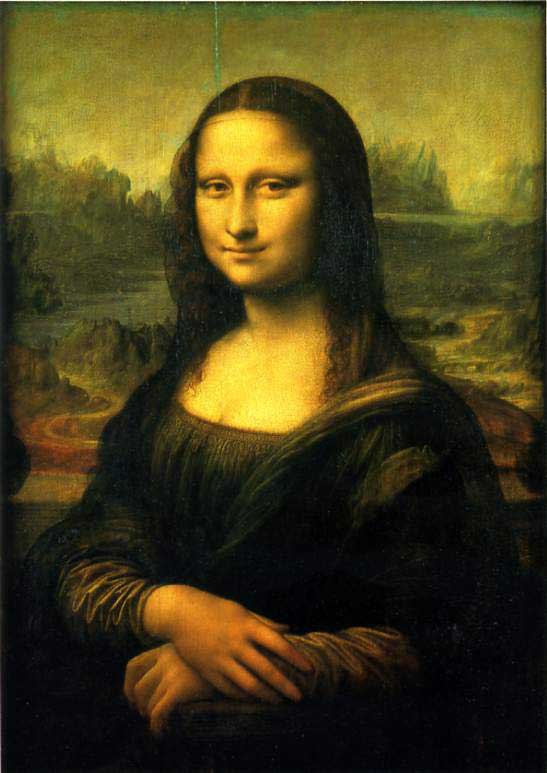
The Not so Mysterious Mona Lisa


If someone were to ask me what is one of my least favorite paintings, I would have to say Leonardo da Vinci’s Mona Lisa. *gasp* WHAT??? Let me explain. I find absolutely nothing wrong with the painting itself but to be frank I’m just sick of always hearing about it. One of the common misconceptions about the painting is that we do not know the identity of the person that it depicts. Consider the title, Mona, meaning “madam,” LISA. Yes, that second part is a name. Most scholars agree that the painting is a portrait of Lisa Gherardini, the wife of Francesco del Giocondo, a wealthy Florentine merchant.  Leonardo da Vinci began painting the Mona Lisa in 1503 and worked on it for four years, but like most of his commissions the painting was never finished and the patrons never received it. In 1516 da Vinci was invited by the King of France, Francis I, to become the king’s court painter. Da Vinci took the Mona Lisa with him and the painting was still in his possession when he died in 1519. Another aspect of the painting that gets a lot of attention is that mysterious smile. That coy slightly upturned mouth, however, is actually a da Vinci trademark and he used it in several other portraits such as his painting of St. John the Baptist and his portrait of Cecilia Gallerani (see below). That smile suddenly becomes a little less unique.


So now you may (hopefully) be wondering what is all the hype about? That was my thought exactly when I got to see—if I could even call it that—the painting with my own eyes. There in one of the capacious galleries of the Louvre hung this tiny (its dimensions are 2’ 6” x 1’ 9”) painting barely visible through the mob of picture-snapping tourists and the blinding glare of flash reflecting off bulletproof glass. So how did the Mona Lisa become one of the most famous paintings in the world? It began on August 21, 1911 when three young men stole the Mona Lisa from the Louvre. Once the theft was discovered there was a mass explosion of media and images of the painting could be seen everywhere in the attempt to recover the Renaissance masterpiece. Suddenly everyone was talking about this painting. Twenty-eight months later in December 1913 the painting was found when one of the thieves tried to sell it to a Florentine art dealer. Ever since, even people who claim to know almost nothing about art know and recognize the Mona Lisa. For more about the theft click on this link. http://www.smithsonianmag.com/arts-culture/Stolen-How-the-Mona-Lisa-Became-the-Worlds-Most-Famous-Painting.html What actually makes the painting interesting, in my opinion are things that cannot be seen by the naked eye and those are the many changes that da Vinci made to the painting in his attempt to perfect it. It is believed he worked on the painting off and on up until his death. The evolution of the painting was revealed several years ago when conservationists used digital scans and infrared technology to reveal details hidden beneath the immediate surface of the painting. For more about what was uncovered click here  http://www.livescience.com/4648-25-secrets-mona-lisa-revealed.html 
So I hope that I've helped to uncover some truth about the world's most famous two-dimensional lady. I'd like to end with a quote--yes I love a good quote so expect more to come. In the words of iconic radio personality Paul Harvey, “And now you know the rest of the story.”